Did you know that the first years of life are crucial for your child’s brain development? How are you taking advantage of this period to stimulate their growth? Are you aware of the benefits that music, art and reading have on the comprehensive development of your child during their first years of life?
The first years of life are crucial because we generate the basis of our way of thinking, it is the time when there is greater brain plasticity, so more neural connections are created through experiences at a speed that will never be achieved again. That is why early stimulation can be a great support at the beginning of life.
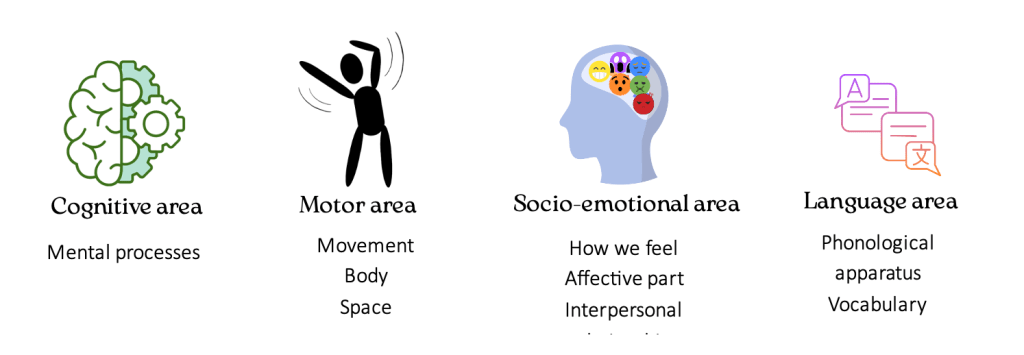
Early stimulation is a set of activities and exercises designed to enhance the physical, cognitive, social and emotional development of children from birth to 6 years of age. These activities focus on taking advantage of brain plasticity in the first years of life to promote motor, linguistic and emotional skills, adapting to the individual pace of each child. To focus the work in a comprehensive way, the objectives to be worked on are organized according to the areas of child development:
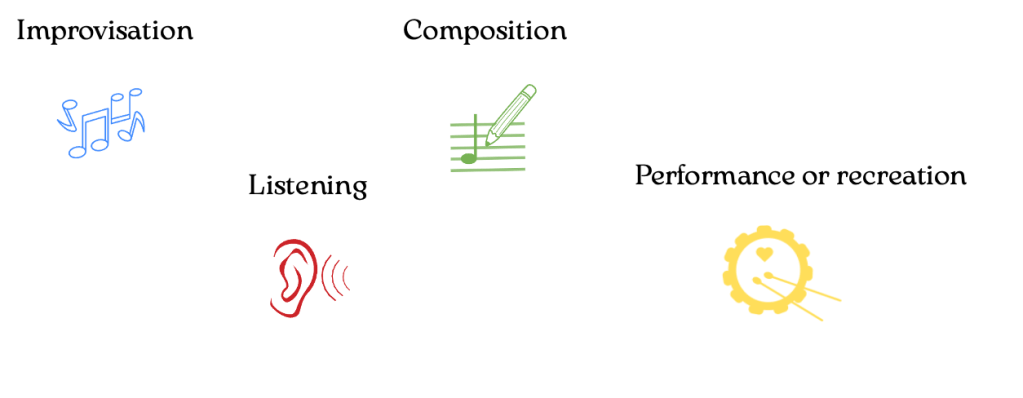
Music therapy in early stimulation is the use of music and its elements (rhythm, melody, sound) to promote the integral development of children. Through activities such as singing, listening to music or playing instruments, key areas of the brain are stimulated, promoting their development in a playful and therapeutic environment. The main practices used in music therapy can be grouped into:
Benefits
The main benefits offered by early stimulation through music therapy are:
- Enhances your attention, concentration and memory
Music promotes neuronal connections and activates multiple areas of the brain involved in auditory processing, motor coordination and memory.
As a multi-sensory experience, music captures your attention and holds your interest with the different changes in rhythm, melody, and tonality, which strengthens your ability to maintain attention for longer periods. Additionally, participating in activities such as listening to songs or playing instruments makes you focus your attention on musical sounds, patterns, and timing, which improves your ability to maintain sustained attention.

Music therapy uses activities such as repeating rhythmic sequences or following the beat of a melody, which trains concentration on specific tasks. By having to follow musical patterns or imitate sounds, they learn to concentrate on a specific activity without being easily distracted.
Repetition of songs and melodies also facilitates learning and improves short- and long-term memory. Boys and girls tend to remember songs, lyrics, and rhythms more easily, which strengthens their auditory memory capacity. In addition, music simultaneously activates both hemispheres of the brain, which favors the retention of information. This double neuronal activation helps children improve both their verbal memory (remembering lyrics and phrases) and their non-verbal memory (remembering melodies and rhythms).
- Strengthens psychomotor skills
The use of sounds, rhythms and combined movements stimulates motor coordination and body control.
Dancing to the rhythm of music or making gestures to accompany a song involves body movements in the musical activity. In this way, they learn to coordinate large muscle groups (legs, arms, trunk) to move in tune with the rhythms, which favours balance and general coordination of the body, improving their gross motor skills.
Fine motor skills are developed by playing small musical instruments that involve control of the muscles in the hands and fingers. These activities require precision and coordination, helping children improve their manual dexterity and also foster hand-eye coordination.
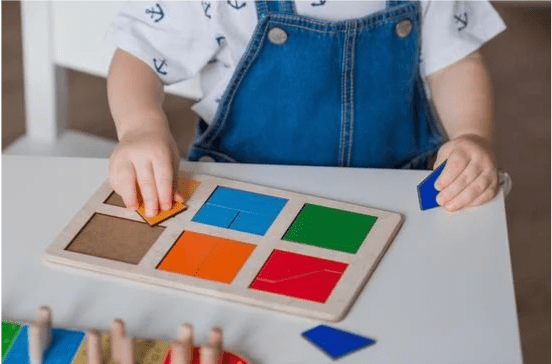
Music therapy also helps improve sensory integration, as auditory (sounds), visual (movements) and tactile (playing instruments) stimuli are processed simultaneously. This combination of senses facilitates the development of complex psychomotor skills by strengthening the connection between the brain and the body.
By following musical rhythms, children improve their synchronisation skills. They learn to coordinate their movements in time, following a constant rhythm, which strengthens overall psychomotor skills and promotes movement control, spatial orientation and coordination. This synchronisation process also encourages motor planning, that is, the ability to prepare and execute sequential movements, which is essential for general motor development.
- Encourages emotional expression
Young children often do not have the vocabulary to express their emotions verbally. Musical improvisation allows children to create sounds and melodies that reflect their internal emotions, helping them to externalise what they are feeling.
Music therapy provides opportunities for children to experience and understand different emotions by listening to different music (melancholic, happy, energetic), thus learning to differentiate and express emotions. In addition, activities such as creating songs or using drums to express themselves allow them to experiment with how to express them in a safe and creative way.
Music has the ability to induce specific emotional states. Soft, slow songs can calm an anxious child, while fast, upbeat rhythms can spark excitement or happiness. This helps children learn to recognise and regulate their emotions, developing emotional self-control skills from an early age.
Musical activities in early stimulation often take place in the presence of adults, such as parents or therapists, which strengthens the emotional bond between the child and his or her environment. These musical interactions help the child feel emotionally safe and understood, which encourages more open and confident emotional expression.

By participating in group musical activities, they not only express their emotions, but also learn to recognise and respond to the emotions of others, fostering empathy.
- Promotes communication and social interaction
Rhythm and songs help improve verbal language acquisition. The repetition of musical phrases and lyrics allows children to identify sounds, syllables, and words. It also improves pronunciation and articulation through vocal games and singing, facilitating the learning of vocabulary and grammatical structure. Additionally, the repetition of musical lyrics, which involves pattern recognition, improves both vocabulary and language comprehension, facilitating more effective communication.
Group musical activities, such as playing together or singing in chorus, teach children to take turns, collaborate, and coordinate with others. These activities require children to listen and respond to the actions of others, fostering key social skills for social interaction such as turn-taking, cooperation, and group participation. Shared musical experiences create a space in which children can naturally interact socially, whether by imitating gestures, participating in rhythmic activities, or responding to the emotions of others through music.
The ability of music to engage emotionally in a group setting creates a space to learn to recognise and respond to the emotions expressed by others. This facilitates empathy and the development of social interaction skills, as children begin to understand how others feel and react. Singing together or playing instruments in sync also reinforces a sense of belonging to a group, helping children form emotional and social bonds with their peers.
Through music therapy, children learn to imitate gestures and rhythmic movements they see in others, which not only improves their non-verbal communication, but also their ability to interact with their peers. Imitation of movements, sounds or melodies facilitates social interaction and group cohesion.
- Stimulates creativity
In music therapy sessions, children can explore different musical instruments freely, discovering how sounds are produced and how to combine them. This freedom of experimentation allows them to use their imagination to create their own melodies and rhythms, encouraging creative thinking. Musical improvisation, where children make up their own sounds or songs in response to musical or emotional stimuli, stimulates spontaneous creativity and allows them to experiment without restrictions.
Improvisation is a central part of music therapy, where children are able to create music in the moment, making decisions about how the music they are producing sounds. This freedom to improvise helps children develop their creative thinking by generating new and unexpected solutions. By choosing which instrument to play or how to perform a song, children are making choices, which reinforces their autonomy.
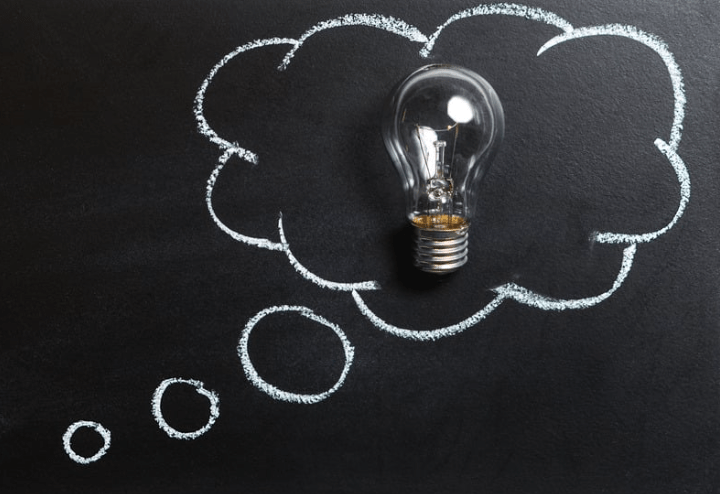
By listening to different types of music, children visualize images or stories in their minds, which stimulates their imagination. Narrative songs or instrumental pieces can inspire children to imagine scenarios or stories, boosting their creative ability to invent new worlds or characters. Using unconventional rhythms and sounds also challenges children to think in novel ways, promoting a more flexible and creative approach to problem solving.
In group music activities, children learn to collaborate creatively. They can make up songs as a team, adapt lyrics, or create new rhythms together with their peers, which reinforces collaborative creativity. This process teaches them to contribute ideas, accept others’ ideas, and build something new together.
Conclusion
In summary, early stimulation through music therapy offers a powerful tool for the comprehensive development of children during the first years of life. By fostering cognitive, emotional, motor and social skills, music therapy not only stimulates brain plasticity, but also helps children express themselves, communicate and connect with the world around them. Through musical activities, children develop their creativity, improve their attention and memory capacity, strengthen their psychomotor coordination and learn to regulate their emotions. Overall, music therapy is presented as a playful and effective strategy that significantly contributes to the healthy and balanced growth of children, laying the foundations for solid emotional, cognitive and social development in their future years.
Bibliografía
Bunt, L., & Stige, B. (2014). Music therapy: An art beyond words (2nd ed.). Routledge/Taylor & Francis Group.
Bruscia, K. E. (2014). Defining Music Therapy. University Park, Illinois: Barcelona Publishers
Hallam, S. (2010). The power of music: Its impact on the intellectual, social and personal development of children and young people. International Journal of Music Education, 28(3), 269–289. https://doi.org/10.1177/0255761410370658
Hijosa, A. y Martin, P. J. (2022). Ideas y recursos musicales desde la afectividad para la primera infancia. Publicado independientemente.
Hou, J., Song, B., Chen, A. C. N., Sun, C., Zhou, J., Zhu, H., & Beauchaine, T. P. (2017). Review on Neural Correlates of Emotion Regulation and Music: Implications for Emotion Dysregulation. Frontiers in psychology, 8, 501. https://doi.org/10.3389/fpsyg.2017.00501
Jurado-Noboa, C. (2018). La musicoterapia neurológica como modelo de neurorehabilitación. Neurologic Music Therapy as a neurorehabilitation model. Revista ecuatoriana de neurología 27(1).
Kim, J., Wigram, T., & Gold, C. (2008). The effects of improvisational music therapy on joint attention behaviors in autistic children: a randomized controlled study. Journal of autism and developmental disorders, 38(9), 1758–1766. https://doi.org/10.1007/s10803-008-0566-6
Kirkaland, K. (2013). International dictionary of music therapy. East Sussex: Routledge.
Malloch, S., & Trevarthen, C. (Eds.). (2009). Communicative musicality: Exploring the basis of human companionship. Oxford University Press.
Nordoff, P., Robbins, C., & Marcus, D. (2007). Creative music therapy : a guide to fostering clinical musicianship (2nd ed. / revised and expanded by Clive Robbins). Barcelona Publishers.
Prada, M. (2020). Crecer felices ante grandes cambios de vida. Cómo acompañar a los niños cuando su día a día se transforma. Madrid: Oberon
Thaut, M. H., & Hoemberg, V. (Eds.). (2014). Handbook of neurologic music therapy. Oxford University Press.
Trimble, M., & Hesdorffer, D. (2017). Music and the brain: the neuroscience of music and musical appreciation. BJPsych international, 14(2), 28–31. https://doi.org/10.1192/s2056474000001720
Wigram, T., Pedersen, I. N. and Bonde, L. O. (2002). A comprehensive guide to music therapy: Theory, clinical practice, research and training. London: Jessica Kingsley.
 Kreativ Musikterapi
Lämna en kommentar