”Do I need to know how to play an instrument?” ”Will you teach me to play?” ”Do I have to sing?” ”Do you learn music in music therapy?” ”If my child receives music therapy, will they later be able to play an instrument?” ”Can someone benefit from music therapy if they don’t like music?”
These are some of the most common questions in music therapy consultations. Although both music therapy and music education use music as a central element, their approach and objectives are very different.

If you or your child enjoy music or believe you could benefit from it, you might have considered exploring music therapy but are unsure about the differences compared to music lessons. In this article, we’ll explain them so you can choose what best suits your needs or interests.
The Role of Music: Means or End?
The main difference between music education and music therapy lies in the role of music.
- In music education, music is the final goal. The aim is to learn to play an instrument, understand music theory, or develop vocal skills. Teaching focuses on technique, precision, and interpretation.
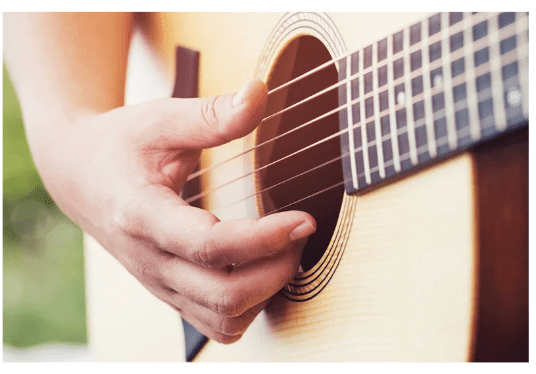
- In music therapy, music is not the goal but the means. It is a tool used to promote emotional, social, or cognitive well-being. It doesn’t matter whether the music produced is ”correct” in technical terms, but rather how it impacts the person experiencing it.
Objectives
Due to this difference in approach, the objectives of each discipline vary significantly:
- In music lessons, the objectives are pedagogical. The student is expected to develop musical skills, improve their technique, and correct mistakes. Progress is measured in terms of musical learning.
- In music therapy, the objectives are therapeutic and personalized. The focus may be on emotional expression, communication, self-esteem, relaxation, or cognitive stimulation, depending on the individual’s needs.
Mistakes
In music education, mistakes are part of the learning process. The goal is to identify execution errors and work on correcting them.

In music therapy, there are no mistakes. It does not matter if an instrument is played ”incorrectly” or if a song is out of tune. What matters is how the person experiences the music and how it helps them in their personal process.
Methodology: Different Approaches
Methodologies also vary depending on the objectives:
- In music lessons, a structured plan is followed, which may include sheet music, technical exercises, and regular practice. Some examples include:
- Suzuki
- Kodály
- Orff
- Dalcroze
- In music therapy, sessions may include improvisation, active listening, vocal use, movement, or interaction with instruments, without requiring prior musical knowledge. Some examples include:
- Nordoff-Robbins
- Analítica
- Guided Imagery and Music (GIM)
- Benenzon
While music education methods aim to develop technical skills, music therapy methodologies are designed to adapt to each person and their therapeutic process, flexibility is key.
Framework
Another fundamental aspect is the framework in which each activity takes place.
Educational Framework (music lessons): There is a defined structure, with clear pedagogical objectives. The teacher guides the learning process and assesses the student’s progress.
Therapeutic Framework (music therapy): A safe space is created where music serves as a vehicle for exploration and expression. There is no performance evaluation, but rather an observation of the impact that music has on the person.
Who provides it?
The professional in charge of each discipline is also different:
Music teacher: A specialist in music pedagogy, instrumental training, or vocal technique. Their role is to teach, correct, and guide the student’s musical development.
Music therapist: A professional with specific training in music therapy, with knowledge in music, psychology, neuroscience, and musical therapy. They design sessions tailored to the emotional, cognitive, or physical needs of each person.
Conclusion
If you want your child to learn to play an instrument, develop their musical skills, or deepen their understanding of music theory, music lessons are the best option.
If, on the other hand, you’re looking for a space where music helps express emotions, improve communication, or address developmental aspects, music therapy is the right alternative.
The most important thing is to understand that it’s not about choosing one over the other, but rather identifying what you truly need or what would benefit your child the most. Music, in any form, will always be an enriching path.
Bibliography
Bunt, L., & Stige, B. (2014). Music Therapy: An Art Beyond Words. Routledge.
Bruscia, K. E. (2014). Defining Music Therapy (3rd ed.). Barcelona Publishers.
Swanwick, K. (1999). Teaching Music Musically. Routledge.
 Kreativ Musikterapi
Lämna en kommentar